Did you know that June is National Accordion Awareness Month, and June 13 has been designated as Kitchen Klutzes of America Day? It seems each day of the month is earmarked for just about anything these days. In fact, according to marketing blogger Priya Anand, there are 46 such designations in June alone. Some have lighter themes, but others are more serious.
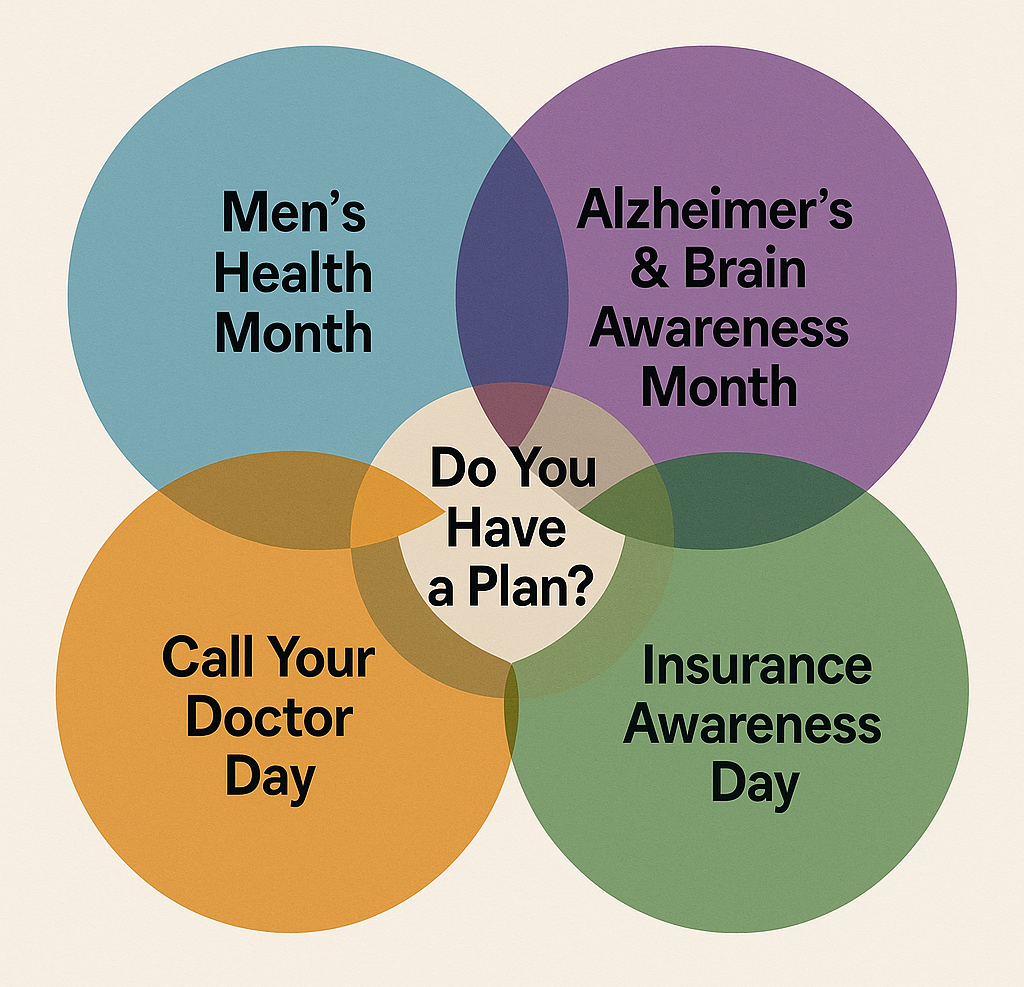
Several of the more legit events recently caught my eye: Men’s Health and Alzheimer’s and Brain Awareness Month, in addition to Call Your Doctor Day (June 2) and Insurance Awareness Day (June 28). As the accompanying Venn Diagram demonstrates, the topics overlap to produce a question where they all come together: Do You Have A Plan? For each? For at least one of them? For all of them?
Let’s do a deep dive into each and take a look at what this could mean for you and your family, and specific financial strategies you might consider.

Men’s Health
Ladies, if you’re reading this, fault me not. May is National Women’s Health Month, and October is both Breast Cancer Awareness and National Women’s Small Business month. So I beg for a tad of wiggle-room as I address my male counterparts and their significant others.
While men’s health concerns are often associated with prostate cancer, testosterone levels, and heart function, another topic that continues to garner attention is mental health. I attended a first responder peer support event not too long ago, and the four keynote speakers – three of them men – openly discussed how they mismanaged their mental health for far too long, and the consequences almost cost each of them their lives. Other than the fact that they were all first responders (plus one spouse), something they all had in common was that they either refused help altogether or simply chose not to ask.
Emotional, physical, and financial wellness are much like that Venn Diagram – a large portion of one or two can profoundly impact the others. Let one slip, and the others surely will feel it. We all have heard or used the phrase “typical male,” which stereotypically labels tough guys who don’t show emotion and refuse to go to the doctor (more on this later).

Alzheimer’s & Brain Awareness
Now more commonly associated with memory care and including dementia, this subject often will cause angst for those who are genetically predisposed to it or are currently living with or caring for someone with it.
Questions arise about long-term care policies and whether someone who has been diagnosed with Alzheimer’s can still obtain an LTC policy. The National Council on Aging article ”Does Long-Term Care Insurance Cover Memory Care? A Comprehensive Guide” does a masterful job addressing this sometimes complex issue and answering common questions about what is covered by a typical LTC policy. At my parents’ assisted living facility in suburban New York City, they have access to memory care services on-site. What a blessing since Dad is 90, and Mom is 88
Perhaps equally as important to consider is respite care for those who provide typically unwavering and sometimes physically and emotionally exhausting support. Policies often include this, and specific riders are available if not. Regardless, it’s vital to make this part of your plan if you find yourself or a loved one navigating these challenging waters.

Call Your Doctor
I did … in May, and I scheduled my annual checkup for early June. If you haven’t, then do it. If you have, even better. There’s no excuse for putting this off.
The Mayo Clinic reports the following: “Historically, men have been hesitant to seek medical attention when something seems wrong with their health. Also, men aren't as likely as women to have preventive screenings and checkups with their healthcare team. … Males older than 50 should have a yearly physical exam, and those younger than 50 should have a physical exam every three to five years.”
Overlapping with this topic is medical insurance. From HMOs to PPOs, self-insurance to the Affordable Healthcare Act, policies abound. Should you go with a lower deductible, thus increasing your out-of-pocket expenses? Should you go with a higher deductible, thus decreasing your out-of-pocket expenses? Which Medicare supplement will cover which services for whichever ailment you’re currently dealing with?
Preventive care seems to be the key, the Mayo Clinic claims in the aforementioned article. Colon cancer, diabetes, high blood pressure and cholesterol, heart disease – you name it. Regular checkups with your healthcare team and the resulting screenings could make all the difference, so make that call – today!

Insurance Awareness
There isn’t enough space here to address every aspect of insurance, so I’ll simplify it: Insurance is simply a matter of transferring risk from one entity to another. You want to drive a sports car? This comes with increased risk. So you pay a higher premium because the risk is higher, and an insurance company assumes that risk more or less on your behalf.
You pay for insurance, hoping you never have to use it, but the reality is that it is an absolute necessity. Yes, a plethora of insurance plans, policies, and products are out there, and they cover everything from disability to accidental death, Medicare supplements to universal, term, and whole life. Where to start?
If it’s life insurance you’re curious about, three main factors are among a bevy of considerations: rent vs. own; your budget; and desired death benefit. Starting with the last, calculating a death benefit means factors like inherited medical traits, longevity risk, and increased taxation (since the surviving spouse would be single) must be figured in. Your budget now must be reconfigured because, again, you would like the survivor to maintain their current quality of life, and so it’s their spending, bills, etc., that take precedence. And finally, rent vs. own has naught to do with where you live and everything to do with term vs. whole life insurance. Term insurance is like renting a house; it’s usually cheaper and provides what you want in a home, but you don’t actually own it or earn any equity. Conversely, whole life is like owning a house; it’s more expensive and provides what you want in a home, but over time, (ideally) your investment ends up increasing in value.
Believe it or not, the previous paragraph is barely the tip of the giant iceberg that is insurance.
Putting Your Plan Together
So let’s sum this up. The Venn Diagram shows a point of convergence where all four topics discussed here – men’s (and women’s) health, memory care, preventative medicine and insurance awareness – result in the essential question: Do You Have A Plan? Meeting with a financial advisor is a great first step to devising a plan and likely the most effective strategy for increasing your understanding of these and other steps necessary to give you the best chance at achieving physical, emotional, and financial wellness. And this is where Everest Financial Inc. comes in. Owner and advisor Joseph Duffey brings over 30 years of industry experience and multiple official designations to the retirement planning table. From first responders to teachers, factory workers to large business owners, Joe’s face-to-face approach demonstrates his genuine concern and passion for helping people work towards sound financial planning.
Spend some time exploring the Everest Financial website, make an appointment with us today by calling 859-291-9290, or go to our Events page and sign up for a seminar. Regardless of which option you choose, take that first step – today!
Who knows? Maybe it will result in "National Take The First Step To Sound Financial Planning Day."